Series · 1990s–2008
Regeneration
Drawings, sculpture and ritual garments, 1990s–2008.
This early strand of Celia de Villiers’ sculptural work and artistic research, made through the 1990s and 2000s, turns on a single idea: renewal. It engages South Africa’s traditional healers and the belief that spent energy, damaged bodies and vanishing knowledge can be regenerated. As a white South African, de Villiers makes no claim to indigenous knowledge; she approaches it speculatively — through research, and through her encounter with the celebrated Zulu sanusi and author Credo Mutwa (Indaba, My Children).
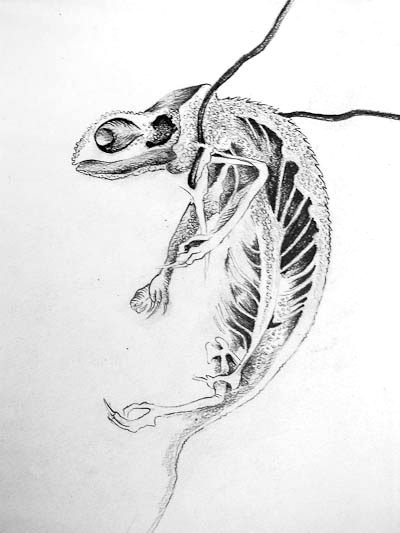
The Bones and Roots drawings came first, made while she researched the materials of animal medicine in the muti shops — dried chameleons, tortoises, a rat, the tangle of roots. Her interest lay in what she calls the fetish value of these objects: the belief that the properties of an animal or thing might transfer to the one who wears or uses it — a power carried, and renewed, from one body to the next.
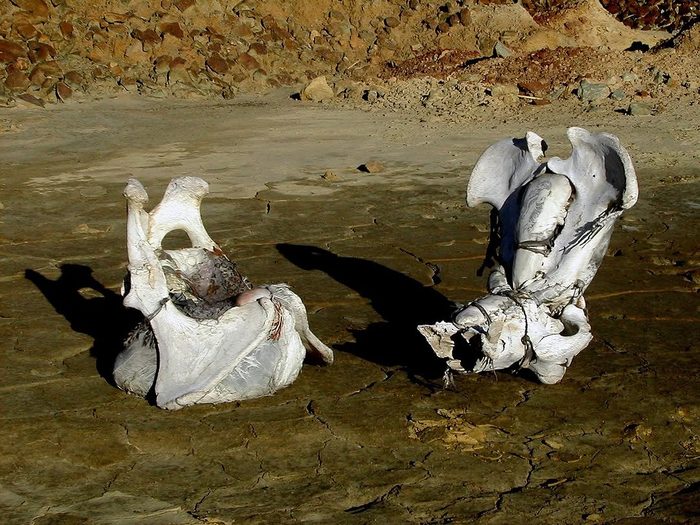
That belief takes its clearest form in Regeneration, which gives the series its name. De Villiers bound a giraffe hip bone and a hippo jaw — given by Kruger National Park rangers, from animals that died of natural causes — with bandages, yarns and silk. The work follows the ethnographer Arnold van Gennep, who in The Rites of Passage saw regeneration as a law of life: the energy in any system is gradually spent, and must be renewed at intervals. The bandaged bones are an image of exactly that renewal — healing, and the passage from one state to the next.
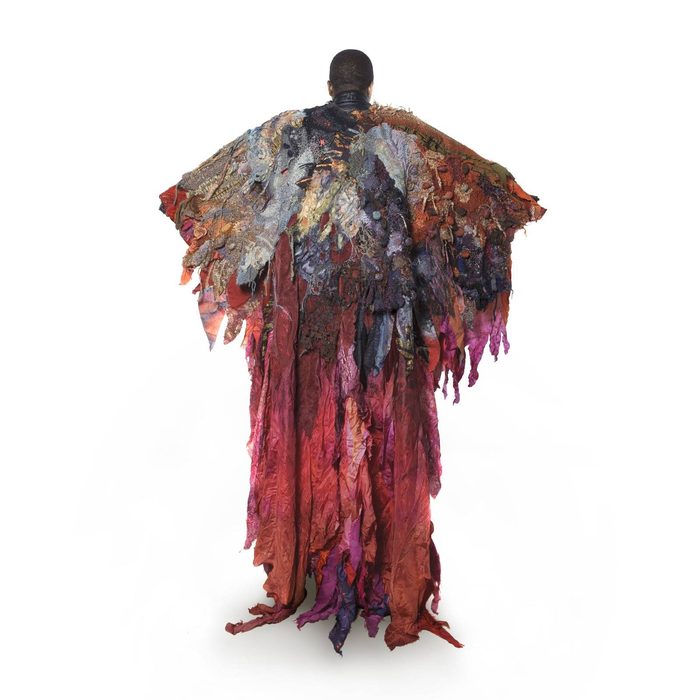
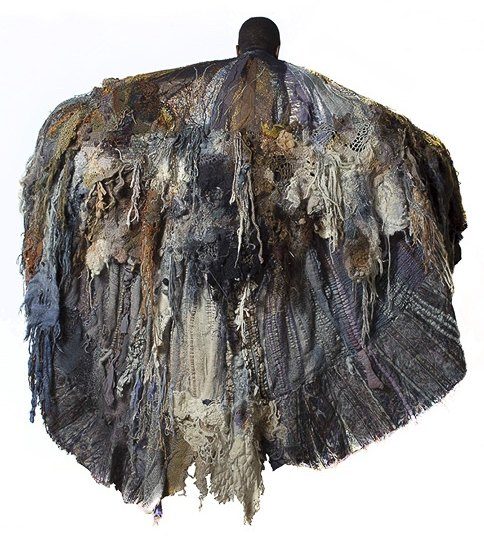
The same impulse — to hold on to something precious before it is lost — drives the ritual garments. Cloak for a Shaman and Forged by Fire — A Cloak for Nommo grew from her interviews with traditional healers; from that tradition, and perhaps from Mutwa himself, comes their central image: that the status of a shaman may be bestowed on the metalworker who controls fire and forges sacred objects. The French sociologist Jacques Ellul had warned that a civilisation’s rites and magical techniques vanish as it fashions its own new stock of technical magic; de Villiers takes that not as prophecy but as a spur — making garments in cloth and felt that try to regenerate a knowledge in danger of being lost. Felt is a material she shares with the German artist Joseph Beuys, who cast the artist as a shaman. In her later work the same fascination with the fetish object turns inward, taking new form in a feminist body politics closer to her own experience.